The Leadership House™
Building healthier organizations through belonging, safety, trust, and agency.
The Leadership House™
A Tool for Trauma-Informed Leadership
The Leadership House™ is a practical leadership tool designed to help leaders and organizations better understand how people and systems adapt to stress, adversity, uncertainty, and change.
Grounded in the core conditions of belonging, safety, trust, and agency, The Leadership House™ provides a simple yet powerful way to explore how organizational conditions influence culture, communication, collaboration, decision-making, and workforce well-being over time.
Used within trauma-informed leadership, organizational consultation, leadership development, and culture-building efforts, The Leadership House™ helps leaders create healthier, more sustainable environments where people can think clearly, navigate complexity, remain connected to purpose, and thrive under pressure.

Why This Tool Matters
Organizations today are navigating increasing levels of complexity, uncertainty, emotional demand, workforce strain, and rapid change. Across healthcare, behavioral health, education, child welfare, nonprofit, and other human-serving systems, leaders and teams are being asked to respond to growing challenges with limited time, resources, and capacity.
Under these conditions, people and organizations naturally adapt. Over time, however, those adaptations can begin to influence communication, trust, collaboration, decision-making, leadership, and organizational culture. Teams may become more reactive, disconnected, overwhelmed, or focused on short-term survival rather than long-term sustainability.
These responses are not signs of failure or weakness. They are often understandable adaptations to chronic stress, adversity, uncertainty, and change.
The Leadership House™ helps leaders better understand these patterns while strengthening the conditions that support healthier adaptation. By focusing on belonging, safety, trust, and agency, leaders can create environments that foster clarity, connection, accountability, resilience, and sustainable performance over time.
The House
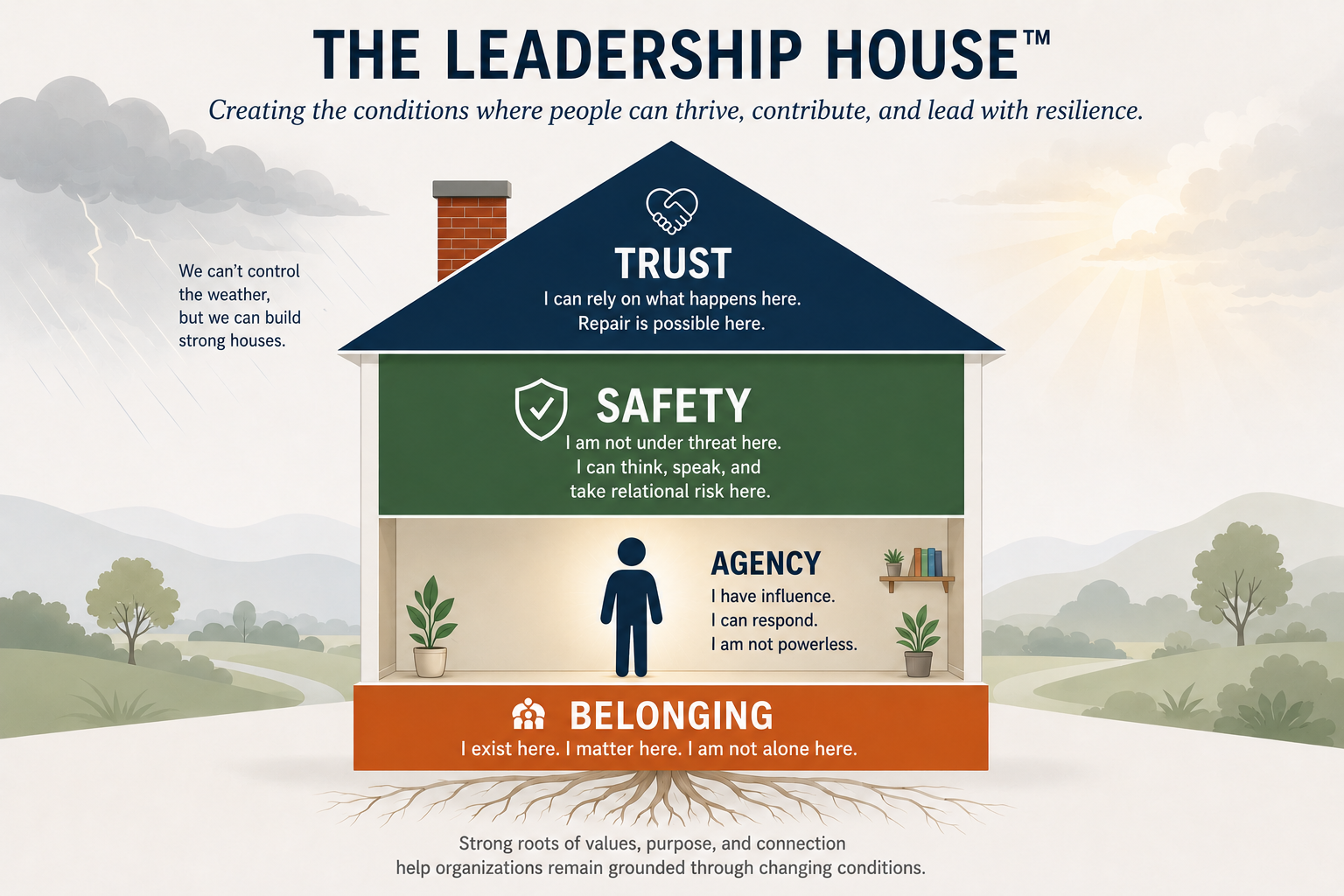
The Leadership House™ uses the metaphor of a house to illustrate the conditions that help people and organizations thrive.
Particularly during periods of stress, adversity, uncertainty, and change, belonging, safety, trust, and agency provide a foundation for healthier adaptation, stronger relationships, and more sustainable leadership.
Each part of the house represents one of these essential conditions.
Belonging - The Foundation
Belonging forms the foundation of the house. When people feel that they matter, are valued, and are connected to something larger than themselves, the nervous system often experiences greater stability and safety.
Belonging does not require agreement or sameness. It means people experience themselves as seen, respected, included, and connected within the organization and its mission.
Without belonging, organizations often become more fragmented, guarded, and disconnected under stress.

Safety - The Walls
Safety provides the structure that allows people to think clearly, communicate openly, ask questions, acknowledge uncertainty, and engage in learning without excessive fear or shame.
This includes both physical safety and psychological safety — the shared belief that people can speak up, make mistakes, express concerns, and participate honestly without fear of humiliation or punishment.
When safety decreases, organizations often become more reactive, risk-averse, and emotionally vigilant.
Trust - The Roof
Trust helps protect and stabilize the house over time. Trust develops through consistency, transparency, reliability, accountability, and the ability to navigate rupture and repair within relationships and systems.
Trust is not built through perfection. It is strengthened when people experience honesty, predictability, responsiveness, and thoughtful repair when harm or misunderstanding occurs.
Without trust, collaboration weakens and organizations often move toward defensiveness, fear, over-control, or disconnection.

Agency - The Life Inside the House
Agency represents the lived experience inside the house — the ability for individuals and teams to think critically, make decisions, contribute meaningfully, influence their environments, and respond flexibly under pressure.
Agency is strengthened when people experience belonging, safety, and trust consistently over time.
When agency is low, organizations often experience helplessness, over-functioning, disengagement, dependency, or chronic reactivity.
The Environment Around the House
Organizations Do Not Exist in Isolation
The Leadership House™ recognizes that organizations operate within broader ecosystems and changing external conditions.
Human-serving systems are often shaped by:
- workforce shortages
- funding instability
- political pressures
- societal stress
- trauma exposure
- urgency cultures
- community needs
- rapid organizational change
- competing demands and limited resources
These external pressures influence the emotional climate, decision-making, communication patterns, and capacity of both leaders and teams.
The goal of trauma-informed leadership is not to eliminate stress or create perfect organizations. It is to strengthen the internal conditions that help people and systems remain connected, thoughtful, adaptable, and sustainable while navigating ongoing complexity and uncertainty.

Explore Ways to Work Together
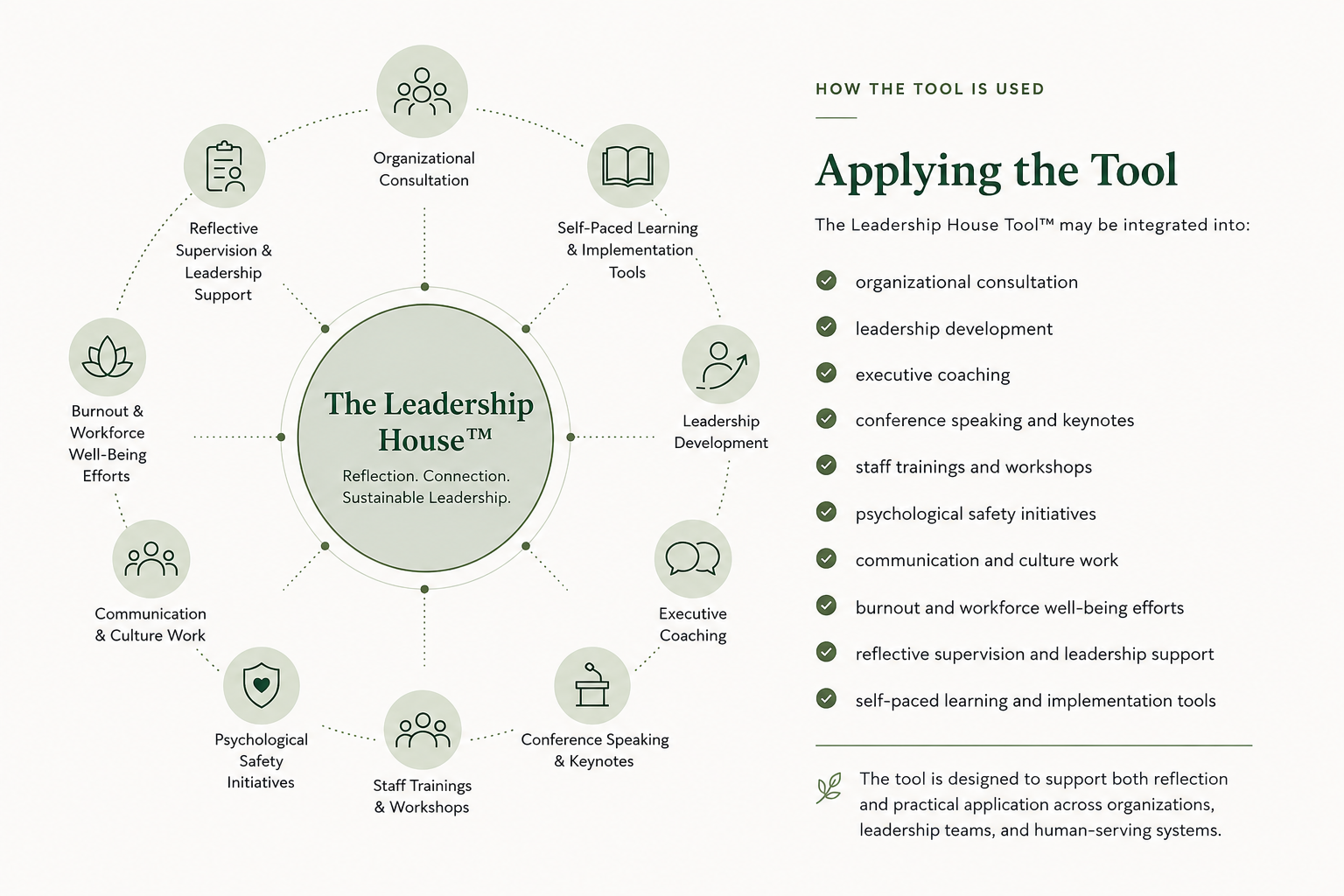
Whether you are seeking organizational consultation, leadership development, executive coaching, or speaking support, I offer multiple ways to engage this work.
Work with Me